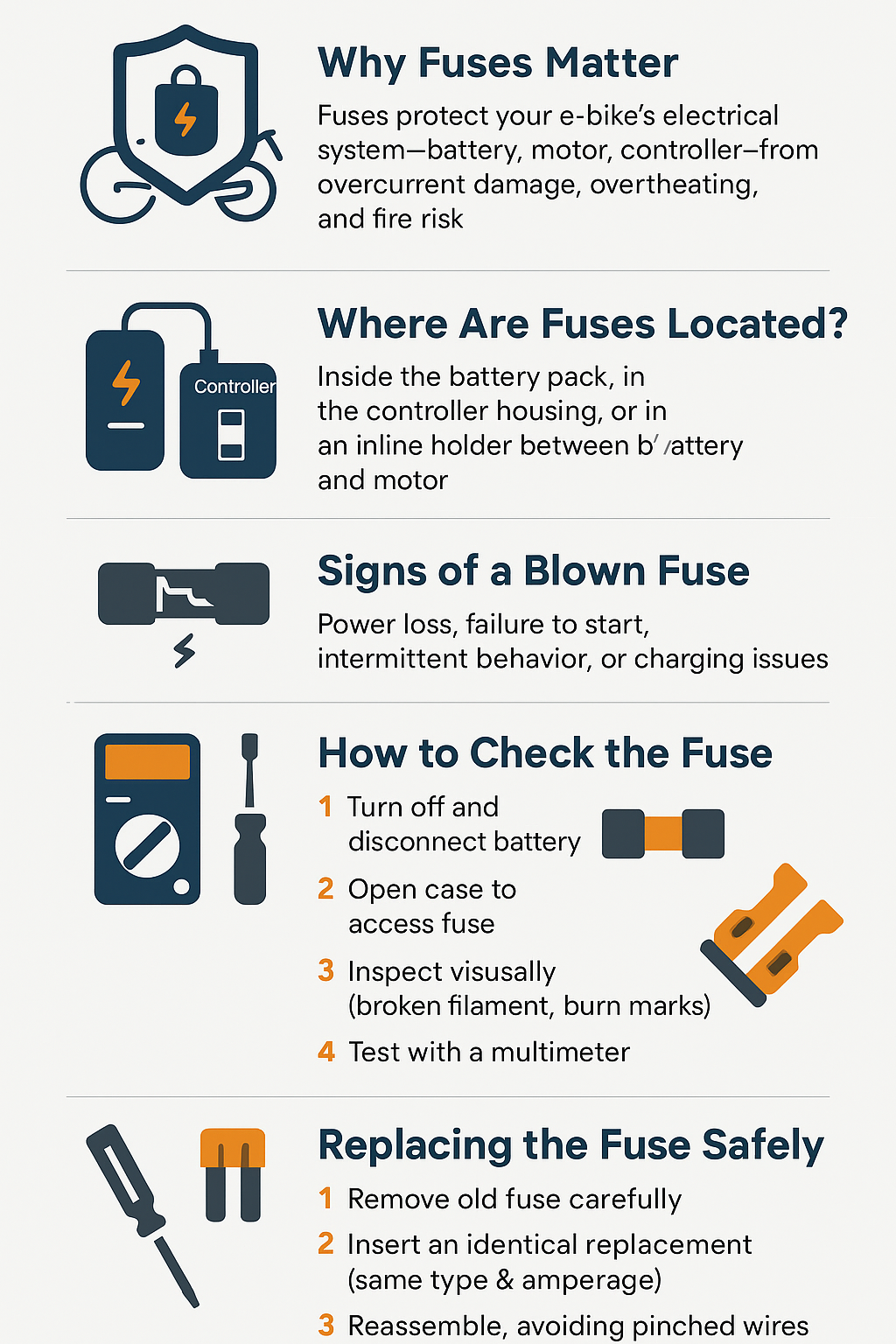
Check and Replace Fuses in E-Bikes: Checks, Fixes, and When to Stop
If your electric bike suddenly loses power or won’t turn on, a blown fuse is the most common and often the easiest fix. This guide will walk you through locating, checking, and replacing your e-bike’s fuse safely. If the problem persists after replacing the fuse, or if you’re uncomfortable with the process, it’s time to seek professional help.
Quick Answer: Fuse Check and Replacement
The most likely reason your e-bike’s electrical system has shut down is a blown fuse. To check, locate your e-bike’s fuse holder (often near the battery connection or on the controller), visually inspect the fuse for a broken filament, and replace it with an identical one if blown. If the new fuse blows immediately, or if you’re unsure about any step, stop troubleshooting and consult your e-bike’s manual or a qualified technician.
Locating Your E-Bike’s Fuse
Fuse locations vary by e-bike manufacturer and model. Common places to find the fuse holder include:
- Near the Battery Connector: Many bikes have a fuse holder integrated into the wiring harness where the battery connects to the main system. This often appears as a small plastic housing with a removable cap.
- On the Controller: The electronic speed controller, which manages motor functions, may have an accessible fuse holder. This unit is typically a black box located within the frame or under a protective cover.
- Integrated into the Power Switch: Some e-bikes have a fuse built directly into the main power switch assembly.
Always refer to your e-bike’s owner’s manual for the exact location and type of fuse used. If you cannot find this information, contact the manufacturer or your local e-bike dealer for assistance.
How to Check for a Blown Fuse
Before you begin any electrical checks, ensure your e-bike is powered off and the battery is disconnected or removed to prevent electrical shock.
1. Identify the Fuse Holder: Locate the fuse holder using the guidance above and your owner’s manual.
2. Access the Fuse: Carefully open the fuse holder. This usually involves pulling off a plastic cap or sliding out a small drawer.
3. Visual Inspection: Remove the fuse. Most e-bike fuses are glass or plastic tubes with metal end caps and a thin wire filament running through the center. A blown fuse will have a visible break in this filament. If the filament appears intact, the fuse is likely not the issue.
4. Test with a Multimeter (Optional): For a more definitive check, use a multimeter set to continuity mode. Touch the probes to each metal end cap of the fuse. If the multimeter beeps or shows zero resistance, the fuse is good. If it shows no continuity (infinite resistance), the fuse is blown.
Replacing a Blown Fuse
If you’ve confirmed the fuse is blown, you’ll need a replacement.
What You’ll Need
- Replacement Fuse: This is critical. The replacement fuse must match the amperage (A) and voltage (V) rating of the original. Using a fuse with a higher amperage rating can damage your e-bike’s electrical components or create a fire hazard. Check the original fuse for markings. If unsure, consult your manual or manufacturer.
- Small Pliers or Tweezers (Optional): For safely removing and inserting the fuse.
- Owner’s Manual: For reference.
Step-by-Step Replacement
1. Ensure Power is Off: Double-check that the battery is disconnected.
2. Remove the Blown Fuse: Gently pull the old fuse out of its holder. If it’s stuck, use small pliers or tweezers to carefully grip the metal end caps and wiggle it free.
3. Insert the New Fuse: Align the new fuse with the holder and push it firmly into place. Ensure it is seated securely.
4. Close the Fuse Holder: Reattach the cap or slide the drawer back into place.
5. Reconnect Battery: Reconnect the battery.
6. Power On and Test: Turn on your e-bike. If the fuse was the sole problem, your e-bike should now power on and function normally. A successful fix means the display lights up, and the motor engages when you pedal or use the throttle.
When to Stop Troubleshooting and Seek Professional Help
While fuse replacement is a common fix, there are situations where you should stop and consult a professional:
- New Fuse Blows Immediately: If you replace the fuse and the e-bike still doesn’t work, or the new fuse blows as soon as you power it on, there is a more significant electrical short or fault in the system. Do not keep replacing fuses, as this could damage other components.
- Corroded or Damaged Fuse Holder: If the fuse holder itself appears corroded, melted, or physically damaged, it needs professional inspection and repair before a new fuse can be safely installed.
- Uncertainty About Fuse Rating: If you cannot determine the correct amperage or voltage rating for your replacement fuse, do not guess. Incorrect fuses can cause serious damage to your e-bike’s electronics.
- Multiple Electrical Issues: If you experience other electrical problems alongside a blown fuse, it may indicate a more complex systemic issue requiring expert diagnosis.
- Battery or Motor Malfunctions: If you suspect issues with the battery pack, motor, or controller beyond a simple fuse problem, it’s best to have a qualified technician diagnose the problem.
Continuing to troubleshoot without understanding the root cause of a recurring blown fuse can lead to more extensive and costly damage to your e-bike’s sensitive electronic components. Always prioritize safety and consult your e-bike’s manual or a certified e-bike repair shop when in doubt.

Ryan Williams has spent over 8 years testing, repairing, and writing about electric bikes. He has personally ridden and reviewed 150+ e-bike models from brands like Lectric, Aventon, Rad Power, Super73, and dozens more.
Before founding EBIKE Delight, Ryan worked as a bicycle mechanic for 5 years at independent bike shops across California, where he specialized in e-bike conversions and electrical system diagnostics. He holds a Certificate in Electric Vehicle Technology from the Light Electric Vehicle Association (LEVA).
Ryan’s work has been cited by Electric Bike Report, Electrek, and BikeRumor. When he is not testing the latest e-bike on California backroads, he is in his workshop tearing down batteries and controllers to understand what makes them tick — and what makes them fail.
Areas of Expertise
E-bike performance testing and real-world range verificationBattery diagnostics, charging best practices, and safetyBrand comparisons: Lectric, Aventon, Rad Power, Super73, and moreError code troubleshooting across major e-bike systemsE-bike laws, registration, and compliance by state
Ryan believes every rider deserves honest, hands-on information — not marketing hype.