Electric Bikes: Legal Requirements in Baton Rouge
If you are comparing options here, MotoTec 36v Pro Electric Dirt Bike 1200w Lithium Orange is a relevant choice worth checking.

- MT-Dirt-Pro_Orange
If you are comparing options here, Bosch Unisex – Adult 2A Compact Gen2 Bicycle Decoration, Black, 1 Size is a relevant choice worth checking.

- Colour: black
- Brand: Bosch
electric bikes legal requirements in baton rouge: Quick Answer
- E-bikes are legally classified into three categories (Class 1, 2, and 3) based on motor assistance type, speed, and throttle presence.
- Compliance hinges on verifying your e-bike’s continuous motor wattage (≤ 750W) and maximum assisted speed.
- Local Baton Rouge ordinances may impose additional restrictions beyond state law, particularly concerning trail and path access.
Who This Is For
- Individuals purchasing or operating electric bicycles within Baton Rouge.
- Current e-bike owners seeking to confirm their compliance with local regulations.
If you are comparing options here, Igo Electric Bikes 005-030 Zoom Stem – 45mm is a relevant choice worth checking.
No products found.
What to Check First
- E-bike Classification: Confirm if your e-bike is Class 1 (pedal-assist only, 20 mph max), Class 2 (throttle-assisted, 20 mph max), or Class 3 (pedal-assist, 28 mph max, no throttle).
- Motor Specifications: Verify the continuous rated power (wattage) and maximum assisted speed as stated by the manufacturer.
- Local Ordinances: Research specific Baton Rouge rules for e-bike access on roads, bike lanes, and multi-use paths.
- Age and Equipment: Be aware of potential age restrictions and mandatory safety equipment for e-bike operation.
Understanding Electric Bikes Legal Requirements in Baton Rouge
The proliferation of electric bicycles (e-bikes) in urban areas like Baton Rouge necessitates a clear understanding of their legal standing. Unlike traditional bicycles, e-bikes are equipped with electric motors that augment rider effort or provide propulsion. To ensure safe integration and equitable access to infrastructure, electric bikes legal requirements in baton rouge are structured around a classification system. This framework distinguishes e-bikes from motorized scooters and motorcycles, defining their permissible use and operational parameters.
At its core, an e-bike’s legal identity is determined by its motor’s continuous power output, the maximum speed it can achieve with motor assistance, and whether it employs a throttle. This classification is crucial, as it dictates where an e-bike can be ridden and under what conditions. Louisiana law, which Baton Rouge follows, generally adopts a three-class system for e-bikes, mirroring standards set by the Bicycle Product Suppliers Association (BPSA).
The Three Classes of E-Bikes
Understanding these classifications is paramount for legal operation:
- Class 1 E-bike: Features a motor that provides assistance only when the rider is pedaling. This pedal-assist function ceases once the bicycle reaches 20 mph. Class 1 e-bikes do not have a throttle.
- Class 2 E-bike: Equipped with a throttle-activated motor that can propel the bicycle without pedaling. The motor assistance, whether from pedaling or throttle, is capped at a maximum speed of 20 mph.
- Class 3 E-bike: Utilizes a pedal-assist motor that can reach a higher maximum speed of 28 mph. These e-bikes must be equipped with a speedometer. Importantly, Class 3 e-bikes are explicitly prohibited from having a throttle.
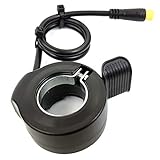
If you are comparing options here, Schuck E-Bike Thumb Throttle 130X,Waterproof Accelerator,22.2mm/0.87in Handlebars,Left/Right Universal Bicycle Conversion Replacement Parts is a relevant choice worth checking.
Key Differentiating Factors for Compliance
The primary technical specifications that define an e-bike’s legal class are its maximum assisted speed and the presence and operation of a throttle. A Class 1 e-bike offers a familiar cycling experience enhanced by motor support up to 20 mph. A Class 2 provides throttle convenience for easier starts or climbing, also capped at 20 mph. Class 3 e-bikes offer a greater speed advantage for commuters and faster riders, reaching up to 28 mph solely through pedal-assist. The absence of a throttle is a defining characteristic of Class 3.
Step-by-Step Plan to Ensure E-bike Compliance
Navigating the electric bikes legal requirements in baton rouge involves a methodical verification process to ensure your specific e-bike meets all criteria.
1. Identify Your E-bike’s Class and Specifications
- Action: Consult your e-bike’s owner’s manual, manufacturer’s website, or any documentation provided at the point of sale.
- What to look for: Explicitly stated classification (Class 1, 2, or 3), the maximum speed at which the motor provides assistance (e.g., 20 mph, 28 mph), and confirmation of whether a throttle is present and its function.
- Mistake: Assuming your e-bike’s class based on its appearance or marketing without verifying the technical specifications. The manufacturer’s stated specifications are the definitive legal markers.
2. Verify Motor Wattage and Output
- Action: Locate the motor’s continuous rated power, typically listed in watts (W).
- What to look for: For an e-bike to be legally classified as such, its motor’s continuous rated power should not exceed 750 watts.
- Mistake: Overlooking motor wattage. A motor exceeding 750W continuous output can reclassify the vehicle as a motor-driven cycle, subject to different and more stringent laws.
3. Confirm Throttle Functionality and Limitations
- Action: If your e-bike has a throttle, test its operation to confirm it engages the motor and observe its speed limitations.
- What to look for: For Class 2 e-bikes, the throttle should activate the motor and propel the bike up to 20 mph. Class 1 and Class 3 e-bikes should not have a functional throttle.
- Mistake: Possessing a throttle on a bike intended or advertised as Class 1 or Class 3, or having a throttle that can exceed the 20 mph limit for Class 2.
4. Research Baton Rouge Specific Ordinances
- Action: Visit the City of Baton Rouge’s official website or contact their Department of Transportation or relevant city agency.
- What to look for: Specific regulations concerning where e-bikes are permitted to operate (e.g., bike lanes, multi-use paths, sidewalks, roads) and any age restrictions for operating certain classes of e-bikes. State law provides a baseline, but local rules can be more restrictive.
- Mistake: Assuming state law covers all local usage. Baton Rouge may have specific restrictions, such as prohibiting Class 3 e-bikes on certain multi-use paths, which are not covered by general state statutes.
5. Check for Required Safety Equipment
- Action: Ensure your e-bike is equipped with standard safety features required for all bicycles.
- What to look for: Functional brakes, appropriate reflectors, and a bell or horn. While not always explicitly tied to e-bike class, these are critical for safe operation and may be mandated by general bicycle laws. Helmets are highly recommended and may be legally required for riders under a certain age.
- Mistake: Neglecting basic safety equipment. This compromises rider safety and can lead to citations if stopped by law enforcement, irrespective of the e-bike’s class.
Common Mistakes and How to Avoid Them
- Myth: All electric bikes are legally the same as traditional bicycles.
- Why it matters: E-bikes have motor assistance, which places them under specific legal definitions that differ from traditional bicycles, impacting where they can be ridden and by whom. This difference is critical for infrastructure access and safety.
- Fix: Understand the three-class system and verify your e-bike’s specifications against these definitions. Consult the City of Baton Rouge’s official transportation guidelines for local nuances.
- Myth: If it has pedals, it’s a bicycle.
- Why it matters: The presence of pedals does not automatically classify a motorized vehicle as a bicycle. The motor’s power, speed capabilities, and throttle function are the primary legal determinants for e-bike classification.
- Fix: Focus on the technical specifications (wattage, speed limits, throttle) when determining legal classification, rather than just the physical appearance. Refer to the manufacturer’s data sheet for concrete figures.
- Mistake: Riding a Class 3 e-bike on a pedestrian-only path or sidewalk.
- Why it matters: Class 3 e-bikes, capable of reaching 28 mph, are often prohibited from multi-use paths and sidewalks to ensure the safety of pedestrians and slower-moving cyclists. Their higher speed poses a significant risk in these environments.
- Fix: Operate Class 3 e-bikes on roads and in designated bike lanes, always yielding to pedestrians and slower traffic. Adhere strictly to posted speed limits for the specific path or road.
- Mistake: Modifying an e-bike to exceed its original class specifications.
- Why it matters: Tampering with motor controllers or speed limiters can reclassify your e-bike as a motor vehicle, potentially requiring registration, insurance, and a driver’s license, which are not typically required for compliant e-bikes. This can lead to significant legal and financial penalties.
- Fix: Do not attempt to “de-restrict” or modify the motor’s power output or speed governor. Keep the e-bike within its certified class limits as defined by the manufacturer.
Expert Tips for Navigating E-bike Laws
BLOCKQUOTE_0
- Tip 1: Maintain Detailed E-bike Records.
- Action: Keep all original purchase documentation, including the sales receipt, manufacturer’s manual, and any specification sheets that clearly detail the motor’s continuous wattage and maximum assisted speed.
- Common Mistake to Avoid: Discarding these crucial documents. They serve as your primary evidence of compliance if your e-bike’s classification is questioned by authorities. Without them, you may have to rely on manufacturer claims that are difficult to verify on the spot.
- Tip 2: Understand Speed Limits Beyond Assisted Speed.
- Action: Familiarize yourself with the posted speed limits for all types of roads and any specific speed restrictions on multi-use paths within Baton Rouge.
- Common Mistake to Avoid: Believing your e-bike’s maximum assisted speed (e.g., 28 mph for Class 3) allows you to ride at that speed everywhere. You are legally obligated to adhere to the posted speed limits of the road or path you are currently using, regardless of your e-bike’s capability.
- Tip 3: Proactively Check Local Regulations Annually.
- Action: Revisit the City of Baton Rouge’s transportation or relevant department website at least once a year to check for updates or changes in e-bike ordinances.
- Common Mistake to Avoid: Assuming that laws remain static. Regulations can evolve based on usage patterns and safety concerns. Staying informed is key to continuous compliance and avoiding unexpected legal issues.
Frequently Asked Questions
- Q: Can I ride my Class 3 e-bike on the levee paths in Baton Rouge?
- A: Typically, Class 3 e-bikes, due to their higher speeds, are restricted from multi-use paths and trails intended for slower recreation. Always check specific signage at the path entrance and consult the City of Baton Rouge’s official ordinances for definitive levee path access rules.
- Q: Do I need a helmet if I’m over 18 and riding a Class 3 e-bike in Baton Rouge?
- A: While Louisiana state law may not mandate helmets for adults on e-bikes, it is highly recommended for safety. Baton Rouge may have specific ordinances or enforcement policies regarding helmet use. Refer to the City of Baton Rouge’s traffic code or contact local law enforcement for the most current requirements.
- Q: What happens if my e-bike is modified and exceeds the 750W limit?
- A: If your e-bike’s motor exceeds 750W continuous rated power or its speed capabilities are significantly altered beyond the defined classes, it may be reclassified as a motor vehicle. This could result in penalties, including fines, and require registration, insurance, and a driver’s license, none of which are typically needed for compliant e-bikes.
| E-bike Class | Pedal Assist Max Speed | Throttle Functionality | Typical Use Restriction in Baton Rouge |
|---|---|---|---|
| Class 1 | 20 mph | None | Generally allowed where bicycles are permitted. |
| Class 2 | 20 mph | Yes | Generally allowed where bicycles are permitted. |
| Class 3 | 28 mph | None | Often restricted from multi-use paths and sidewalks; typically intended for roads and bike lanes. |

Ryan Williams has spent over 8 years testing, repairing, and writing about electric bikes. He has personally ridden and reviewed 150+ e-bike models from brands like Lectric, Aventon, Rad Power, Super73, and dozens more.
Before founding EBIKE Delight, Ryan worked as a bicycle mechanic for 5 years at independent bike shops across California, where he specialized in e-bike conversions and electrical system diagnostics. He holds a Certificate in Electric Vehicle Technology from the Light Electric Vehicle Association (LEVA).
Ryan’s work has been cited by Electric Bike Report, Electrek, and BikeRumor. When he is not testing the latest e-bike on California backroads, he is in his workshop tearing down batteries and controllers to understand what makes them tick — and what makes them fail.
Areas of Expertise
E-bike performance testing and real-world range verificationBattery diagnostics, charging best practices, and safetyBrand comparisons: Lectric, Aventon, Rad Power, Super73, and moreError code troubleshooting across major e-bike systemsE-bike laws, registration, and compliance by state
Ryan believes every rider deserves honest, hands-on information — not marketing hype.
Last update on 2026-06-20 / Affiliate links / Images from Amazon Product Advertising API