Mid Drive Motor: Cadence vs Torque Sensor Explained
If you’re choosing between a mid-drive e-bike with a cadence sensor and one with a torque sensor, the short answer is: a torque sensor gives a natural, proportional feel that mimics stronger legs, while a cadence sensor delivers a fixed assist level the moment the pedals turn, regardless of effort. For most riders who want responsive handling on hills or trails, a torque sensor is the better long-term investment. For flat commutes on a tight budget, a cadence sensor works fine—but you’ll trade ride quality and efficiency for the lower upfront cost.
Quick answer
A cadence sensor triggers motor assist based purely on pedal rotation; it doesn’t know how hard you’re pushing, so it delivers the same preset power in Eco or Turbo until you stop pedaling or hit the speed limit. A torque sensor measures the actual force you apply to the pedals and scales assist proportionally. This means a torque sensor feels like an extension of your legs, while a cadence sensor feels like a switch. If you want a natural, intuitive ride that responds to your effort (especially on hills, in traffic, or off-road), the torque sensor is the clear winner. If you’re keeping costs low and riding mainly flat pavement, cadence-sensing mid-drives are perfectly adequate and easier to maintain.
Comparison framework
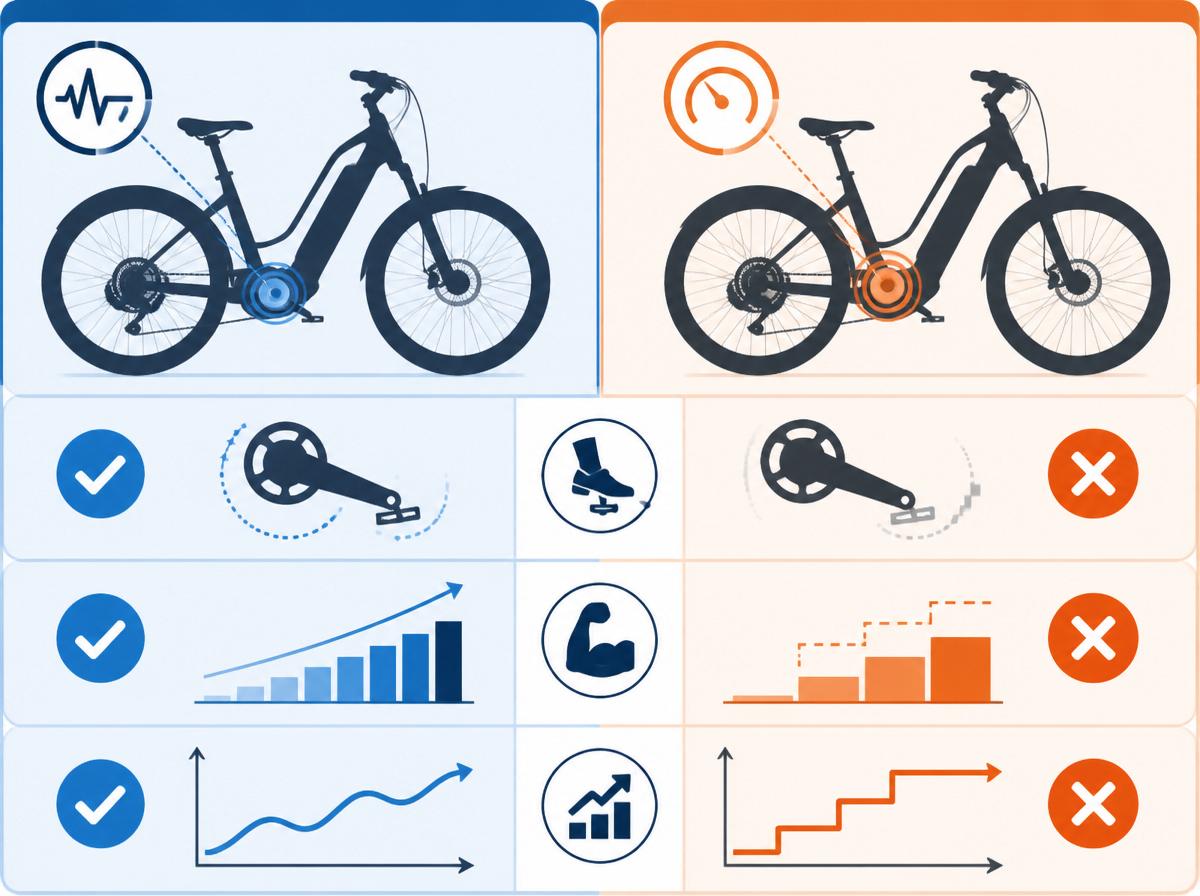
| Feature | Cadence Sensor | Torque Sensor |
|---|---|---|
| Assist trigger | Pedal rotation (on/off or stepped) | Pedal force (continuous proportional) |
| Riding feel | Surges to a fixed power level; can feel abrupt | Smooth, intuitive, like having stronger legs |
| Efficiency | Less efficient on hills and starts; tends to drain battery faster per mile | More efficient—matches assist to demand, extends range |
| Hill climbing | Often requires downshifting to keep cadence high; power can cut abruptly when you stop pedaling | Closely follows your effort; easier to maintain steady speed |
| Cost | Lower—standard on entry-level and many mid-range mid-drives | Higher—adds $100–$300 to motor price |
| Maintenance | Simple Hall-effect sensor; rarely fails | More complex strain-gauge or magnetostrictive sensor; can drift or fail if water gets in |
| Best for | Flat terrain, casual cruising, budget builds | Hills, off-road, fitness riding, riders who want a natural bike feel |
How to check which sensor your bike has
You don’t need to disassemble the motor. Look at the display: when you start pedaling from a stop, does the assist kick in instantly at a fixed power level, or does it ramp up smoothly as you push harder? Another test: pedal lightly at a steady speed on flat ground. If the motor keeps giving the same assist even when you barely touch the pedals, you have a cadence sensor. If the motor output drops when you reduce pedal pressure, it’s a torque sensor. For a definitive answer, pull the motor’s specification sheet or look for terms like “torque sensor equipped” on the bike’s product page. Many brands (Bosch, Shimano, Brose, Yamaha) clearly label torque-sensing models; cadence-only mid-drives are often from budget-oriented suppliers like Bafang (M400) or Tongsheng (TSDZ2B).
A realistic mismatch: when cadence fails on hills
Imagine approaching a steep hill on a cadence-sensor e-bike. You’re pedaling in a moderate gear, the motor is pushing, and you need to downshift. As soon as you stop pedaling for the gear change, the motor cuts out. Now you’re starting from near-zero assist midway up the hill, with a heavy bike and limited leg power. That sudden loss of support can cause you to stall or wobble. On a torque-sensor bike, you can keep steady pedal pressure through the shift, and the motor smoothly adjusts its assist to match your reduced cadence. That concrete consequence—stalling on a grade—is why experienced off-road and hill-commute riders almost always prefer torque sensors.
Testing for fit on your actual bike
If you already own a mid-drive e-bike and aren’t sure which sensor type you have, try this simple roadside verification: stop pedaling completely while riding at 10 mph on a flat road, then slowly start pedaling again. A cadence sensor will give a distinct “push” as soon as the crank completes about a quarter turn, and that push will feel the same regardless of how lightly you’re pressing. A torque sensor will start with a very gentle assist that builds only as you push harder. If the push feels the same whether you barely touch the pedals or stomp on them, it’s a cadence sensor. If you feel the assist fade when you lighten your pedal pressure, it’s a torque sensor.
Best-fit picks by use case
Daily commuter on paved roads
If your commute is mostly flat and you don’t mind the on/off feel, a cadence-sensing mid-drive saves money and is reliable. Many commuter e-bikes in the $1,500–$2,500 range use cadence-sensing mid-drives (like the Bafang M400). For stop-and-go traffic, though, the jerky acceleration of a cadence sensor can make tight maneuvers less comfortable. A torque sensor smooths out starts and reduces the risk of overtightening in a turn.
Hilly terrain or off-road riding
Torque sensors are the default choice here. On steep grades, a torque sensor lets you maintain a steady cadence while the motor scales assist to your pedal pressure. A cadence sensor forces you to either downshift and pedal faster to stay in the same assist band, or accept inconsistent power delivery that can unsettle the bike on loose surfaces. For technical single-track, the proportional response of a torque sensor gives better traction control and more confidence when climbing over obstacles.
Fitness rider who wants to work hard
A torque sensor is essential. Because assist mirrors your effort, you can target a specific heart rate zone without fighting against a fixed power level. Most fitness-oriented e-bikes (like the Specialized Turbo Vado or Bosch Performance Line models) use torque sensors. Cadence sensors tend to make pedaling feel “empty” at high cadences because the motor does the work, reducing the workout benefit. If your goal is to get a genuine leg workout, a cadence sensor will consistently underdeliver on that front.
Budget-conscious shopper
A cadence-sensing mid-drive (e.g., Bafang M400 or Tongsheng TSDZ2B) can save $200–$400 compared to a torque-sensing equivalent (Brose, Bosch Performance Line CX). If you don’t mind the less natural feel and plan to ride mostly flat, smooth surfaces, the cadence option is fine. Just know that battery drain may be 10–20% higher because the motor often overshoots the power you actually need. For example, on a 40‑mile route, that could mean needing a recharge stop that a torque-sensor bike could skip.
Trade-offs to know
Power delivery predictability
Cadence sensors feel jerky when you start or stop pedaling. Some newer systems use a “soft start” ramp, but the transition is still less natural than torque-sensor response. Torque sensors can feel sluggish if the manufacturer tunes them with a very gentle curve—a trade-off some riders dislike because the motor seems weak at low cadences. That tuning is often done to improve battery life, so a torque sensor that feels “too slow” off the line may actually be optimizing range.
Battery range impact
Because a cadence sensor delivers fixed power regardless of demand, it often pushes more watts than necessary, especially on flat ground. All else equal, this can reduce range by 10–20% compared to a torque-sensor system. For a rider doing 50‑mile mixed-terrain rides, that difference could mean the difference between finishing with 10% battery or running out two miles from home.
Durability and weather resistance
Cadence sensors are sealed units with no moving parts exposed to pedal stress—they rarely fail. Torque sensors are more complex; strain gauges can drift over time, and water ingress around the bottom bracket can cause errors. Most torque sensors are well-sealed, but if you ride in heavy rain or pressure-wash your bike, a cadence sensor is more forgiving. One concrete failure mode: after repeated wet rides, water can corrode the pin connections on a torque-sensor harness, causing erratic assist or a permanent error code that requires motor replacement. That repair can cost $300–$500 and involve weeks of downtime.
Related Articles
- Bafang vs Tongsheng Mid-Drive Motors: Cadence Sensor vs Torque Sensor Showdown
- Mid-Drive vs Hub Motor E-Bikes: The Definitive 2026 Comparison Guide
- Hub Motor vs. Mid-Drive E-Bikes: Which is Best?

Ryan Williams has spent over 8 years testing, repairing, and writing about electric bikes. He has personally ridden and reviewed 150+ e-bike models from brands like Lectric, Aventon, Rad Power, Super73, and dozens more.
Before founding EBIKE Delight, Ryan worked as a bicycle mechanic for 5 years at independent bike shops across California, where he specialized in e-bike conversions and electrical system diagnostics. He holds a Certificate in Electric Vehicle Technology from the Light Electric Vehicle Association (LEVA).
Ryan’s work has been cited by Electric Bike Report, Electrek, and BikeRumor. When he is not testing the latest e-bike on California backroads, he is in his workshop tearing down batteries and controllers to understand what makes them tick — and what makes them fail.
Areas of Expertise
E-bike performance testing and real-world range verificationBattery diagnostics, charging best practices, and safetyBrand comparisons: Lectric, Aventon, Rad Power, Super73, and moreError code troubleshooting across major e-bike systemsE-bike laws, registration, and compliance by state
Ryan believes every rider deserves honest, hands-on information — not marketing hype.