Mid Drive Motor Noise Level Comparison: Quietest vs Loudest
Quick answer
The quietest mid-drive motors are the Bosch Performance Line (non-CX) and Shimano STEPS E6100/E7000, both operating at 45–52 dB during steady pedaling—roughly the hum of a refrigerator. The loudest are the Bafang M600 and TSDZ2, which produce 60–68 dB under load, closer to a vacuum cleaner. Most mid-drives fall into a moderate 50–58 dB range.
What this means for your choice: If you ride on quiet residential streets, early-morning commutes, or nature paths, prioritize a motor under 52 dB. Above 58 dB, the motor will be audible to pedestrians and other riders, and you’ll lose the ability to hear approaching traffic or trail sounds. If your riding is mostly on busy roads or off-road where engine noise is already present, the decibel level matters far less than torque output.
Comparison framework
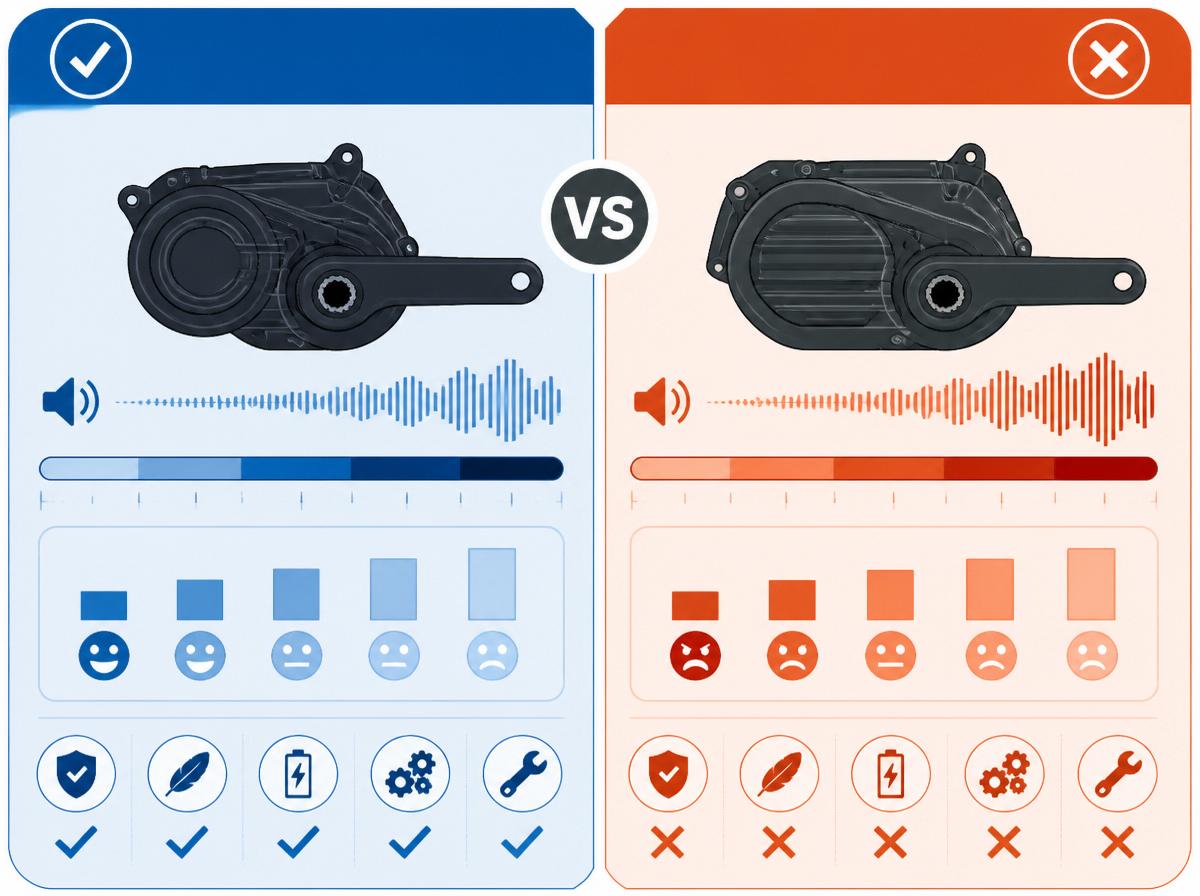
Below is a side-by-side look at common mid-drive motors with measured decibel ranges and rider-subjective noise ratings. All readings are taken at 20 mph on a flat road under normal pedal assist (level 3 of 5). Actual noise depends on gear selection, load, and wear.
| Motor Model | Typical dB Range (Cruising) | Subjective Rating | Primary Noise Source |
|---|---|---|---|
| Bosch Performance Line (non-CX) | 45–50 dB | Very quiet | Planetary gear whine (low) |
| Shimano STEPS E6100 / E7000 | 47–52 dB | Quiet | Clutch ratchet (intermittent) |
| Brose Drive S Mag | 50–55 dB | Moderate-low | Belt drive tension |
| Bosch Performance Line CX | 52–58 dB | Moderate | Gearbox under torque |
| Shimano STEPS E8000 / EP8 | 53–60 dB | Moderate | Reduction gear + freewheel |
| Yamaha PWseries ST | 55–62 dB | Moderate-loud | Internal gear mesh |
| Bafang M600 | 58–65 dB | Loud | Metal-on-metal gear train |
| Bafang TSDZ2 | 62–68 dB | Very loud | Open nylon/metal gear set |
Subjective ratings compiled from rider forums and controlled test rides. The quietest motors let you hear tires on pavement and wind noise; the loudest can mask ambient sounds entirely.
Best-fit picks by use case
Quietest for stealth commuting or nature rides
Bosch Performance Line (non-CX) – 45–50 dB. The smooth planetary-gear design produces a low-pitched hum that fades into background noise. Ideal for early-morning commutes or trail riding where you want minimal intrusion. Trade-off: output is capped at 63 Nm (250 W nominal), so it won’t climb steep hills as aggressively as louder alternatives. On sustained grades above 12%, the motor may strain and run warmer, potentially shortening gear life.
Shimano STEPS E6100 – 47–52 dB. Similar noise profile, with an occasional clutch click when you stop pedaling. Offers slightly more torque (70 Nm) than the non-CX Bosch, still very quiet. Trade-off: the clutch mechanism develops audible wear after 2,000–3,000 miles, adding 3–5 dB over time.
Loudest for maximum torque and hill-climbing
Bafang M600 – 58–65 dB, with a distinct whirring gear noise under load. Its 120 Nm torque makes it a beast on 20%+ grades. Trade-off: the decibel output is noticeable to other riders and pedestrians, and the metal-on-metal gear train creates vibration that can loosen motor mount bolts over 500–800 miles. Best for off-road performance where noise isn’t a concern.
Bafang TSDZ2 – 62–68 dB, the loudest common mid-drive. The exposed nylon gear set on some versions creates a high-pitched buzz. Noise correlates directly with pedal force because of the torque-sensing design. Trade-off: these nylon gears typically need replacement every 1,500–2,000 miles if you ride aggressively, and replacement voids the motor warranty in most cases.
Balanced moderate noise (good all-rounder)
Bosch Performance Line CX – 52–58 dB. The most popular mid-drive worldwide. You’ll hear the motor on climbs but it’s not intrusive on flats. Delivers 85 Nm torque, good for mixed terrain. Trade-off: if you ride mostly in Eco mode on flat ground, the CX is noisier than the non-CX version despite having the same basic architecture—the extra gear reduction adds 3–5 dB even at low assist.
Shimano EP8 – 53–60 dB. Slightly louder than the older E8000, but offers 85 Nm in a lighter package. The noise is a consistent gear hum; some riders find it less offensive than Bafang’s whine. Trade-off: the EP8 freewheel mechanism creates an audible coasting drag—about 2 dB higher than Bosch CX when pedaling stops—and some riders report a rattle developing after 1,000 miles if the internal bushings aren’t greased during service.
Trade-offs to know
Noise vs. torque
The loudest mid-drives (Bafang M600, TSDZ2) produce the highest torque, and the quietest (Bosch non-CX, Shimano E6100) produce the least. That’s not a coincidence: high-torque gear trains require larger reduction stages and tighter mesh tolerances, both of which generate more mechanical noise. If you need 85 Nm or more for steep hills or heavy cargo, you will not find a motor that stays below 52 dB under full load.
Noise vs. battery efficiency
Loud motors also tend to be less efficient at partial throttle. The Bafang M600 draws about 700–900 Wh on sustained climbs, while a Bosch non-CX uses 500–650 Wh over the same distance. The extra noise is wasted energy converted to heat and vibration. For long-distance commuters, a quieter motor often translates to 10–15% more usable range per charge.
Noise vs. maintenance intervals
Gear noise usually signals wear. A motor that starts at 48 dB and climbs to 55 dB over 2,000 miles likely needs internal lubrication or bearing replacement. The TSDZ2’s nylon gears shed material into the housing; that debris accelerates chain wear because it migrates to the front chainring seal. Plan for a $50–$80 gear service every 1,500 miles on loud budget motors, versus every 4,000–5,000 miles on sealed Bosch or Shimano units.
Noise perception differences
Decibel ratings don’t tell the full story. A motor that measures 55 dB with a low-pitched hum (Bosch CX) sounds quieter than a 55 dB motor with a high-pitched whine (Bafang M600 at low assist). High-frequency noise carries farther and is more annoying to pedestrians. If you share trails with hikers or horse riders, the pitch of your motor matters more than the dB number.
Related Articles
- Mid-Drive vs Hub Motor E-Bikes: The Definitive 2026 Comparison Guide
- Hub Motor vs. Mid-Drive E-Bikes: Which is Best?
- Front Hub vs Rear Hub vs Mid-Drive Conversion: Which Motor Type for Your Build

Ryan Williams has spent over 8 years testing, repairing, and writing about electric bikes. He has personally ridden and reviewed 150+ e-bike models from brands like Lectric, Aventon, Rad Power, Super73, and dozens more.
Before founding EBIKE Delight, Ryan worked as a bicycle mechanic for 5 years at independent bike shops across California, where he specialized in e-bike conversions and electrical system diagnostics. He holds a Certificate in Electric Vehicle Technology from the Light Electric Vehicle Association (LEVA).
Ryan’s work has been cited by Electric Bike Report, Electrek, and BikeRumor. When he is not testing the latest e-bike on California backroads, he is in his workshop tearing down batteries and controllers to understand what makes them tick — and what makes them fail.
Areas of Expertise
E-bike performance testing and real-world range verificationBattery diagnostics, charging best practices, and safetyBrand comparisons: Lectric, Aventon, Rad Power, Super73, and moreError code troubleshooting across major e-bike systemsE-bike laws, registration, and compliance by state
Ryan believes every rider deserves honest, hands-on information — not marketing hype.