Mr Tuffy vs Tannus Armour: Which Tire Liner Protects Your E-Bike Best?
If you ride an e-bike, you know tire punctures are more than a nuisance—they can leave you stranded miles from home. Two popular aftermarket liners, Mr Tuffy and Tannus Armour, promise to stop flats before they happen. The short answer: Mr Tuffy is the practical choice for most e-bike commuters due to its easier installation and lower price, while Tannus Armour offers heavier-duty protection for riders who face extreme debris or razor-sharp hazards. However, the right pick depends on your tire width, riding terrain, and willingness to wrestle with a stiff liner. Here’s how they compare and which one fits your ride.
Quick answer
For typical e-bike use—paved roads, bike paths, and light gravel—Mr Tuffy provides reliable puncture protection with a simpler install and a lower cost. If you ride through construction zones, glass-laden urban streets, or thorn-heavy trails, Tannus Armour’s thicker, more rigid construction gives you an extra safety margin, but at the cost of trickier installation and a slightly stiffer ride feel.
Applicability boundary: These liners are designed for standard tube-type e-bike tires in common widths (2.0–2.5 inches). If your e-bike uses tubeless-ready wheels, very narrow road tires (under 1.5 inches), or fat tires (over 3.5 inches), the fit changes. Narrow tires may not have enough internal space for a thick liner, and fat tires may need a wider liner size than either brand offers. Before buying, measure your tire’s inner width and compare with the liner’s stated size range.
Practical implication for your next step: Start with Mr Tuffy if you want a low-effort upgrade that covers 90% of urban puncture risks. Only step up to Tannus Armour if you’ve already experienced repeated flats from sharp debris or if you regularly carry heavy loads on rough surfaces. The extra installation time and stiffer ride of Tannus Armour are worth it only when the threat level is consistently high.
Comparison framework
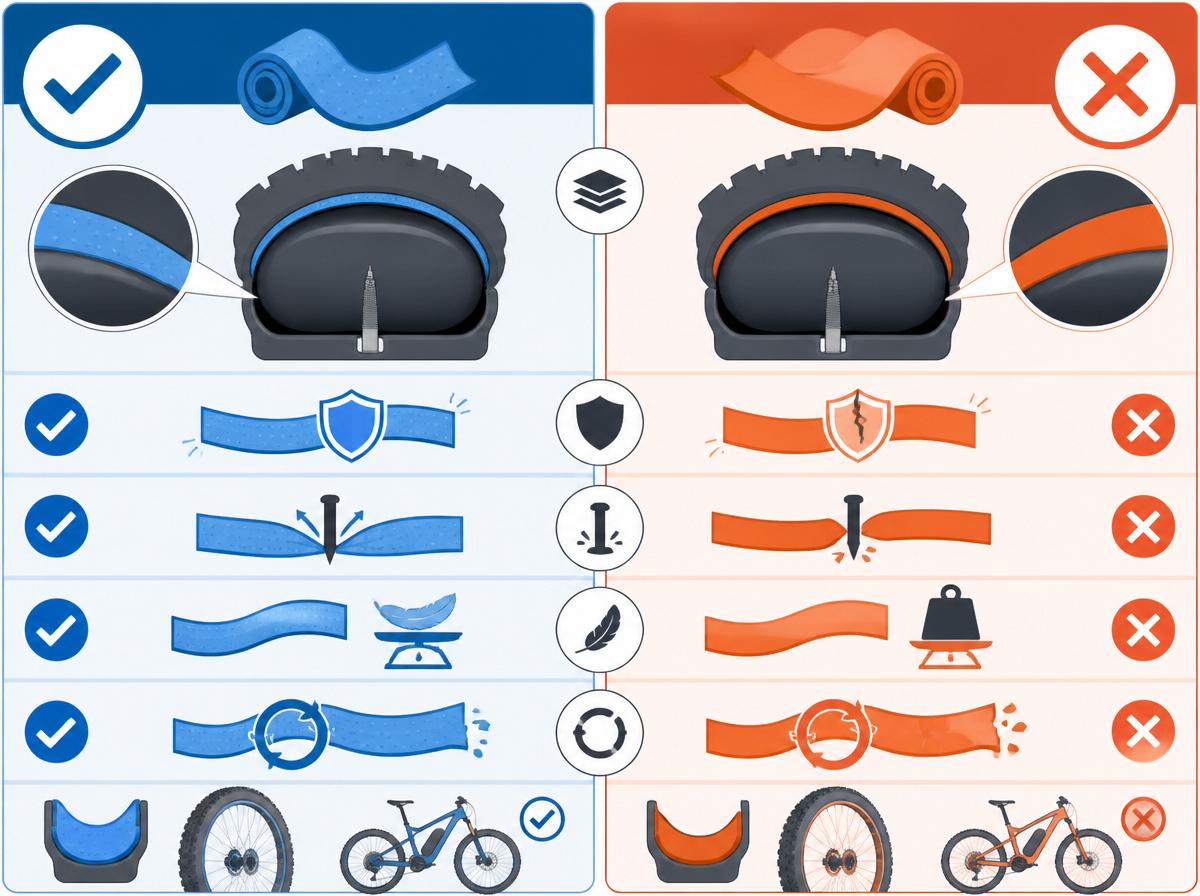
Both liners sit between the tire and tube (or between tire and rim for tubeless setups) to block sharp objects. The key differences come down to material thickness, installation effort, and how they affect ride quality—especially on heavier e-bikes.
| Feature | Mr Tuffy | Tannus Armour |
|---|---|---|
| Material | Flexible polymer (about 1/16″ thick) | Rigid, thick polyurethane (about 3/16″ thick) |
| Weight (per liner) | ~3–4 oz for typical 26″ size | ~8–10 oz for typical 26″ size |
| Puncture protection | Good against glass, thorns, small nails | Excellent against larger debris, industrial staples, sharp metal |
| Installation difficulty | Easy—can be trimmed with scissors, slides in | Difficult—requires careful trimming, stiff to insert, may need tire levers |
| Ride feel | Minimal change from normal tire feel | Noticeably firmer; reduces tire compliance |
| Price (typical pair) | $15–$20 | $40–$50 |
| Compatibility | Works with most standard tubes and tubeless setups | Works best with thicker tires (2.0″ or wider); may be too thick for narrow road tires |
Key mechanism for e-bikes: E-bikes add 20–60 lb of motor and battery weight plus higher forward torque from the hub or mid-drive. That extra force increases the chances of a puncture when hitting a sharp object. A liner that deflects the object before it reaches the tube is even more important on an e-bike than on a standard pedal bike. The liner’s ability to stay in place under higher vibration and torque matters; Mr Tuffy’s flexibility lets it conform better, while Tannus Armour’s rigidity can shift if not trimmed precisely.
Verification step to confirm fit: Remove the tire and tube, then lay the liner flat on the rim bed. The liner should be at least 1/4 inch narrower than the inner width of the rim to avoid bunching when the tire is inflated. Also, hold the liner against the inside of the tire casing—if the liner’s width exceeds the tire’s internal width, it will pinch the tube and cause a slow leak. Trim the liner with scissors to fit; both brands allow trimming, but Mr Tuffy is easier to cut cleanly.
Best-fit picks by use case
For daily commuters on paved roads: Mr Tuffy
If your e-bike sees mainly asphalt, concrete, and occasional light gravel, Mr Tuffy gives you the best balance of protection and ease. You can install it in under 15 minutes without removing the wheel (if you’re comfortable working on a partially inflated tire). The thin profile doesn’t add noticeable rolling resistance or vibration, so your e-bike’s range and ride comfort stay close to normal. At $15–$20 for a pair, it’s an affordable upgrade for a bike that might already cost $1,500–$4,000.
One potential failure mode: If you install Mr Tuffy with the ends overlapping instead of butted together, the overlap creates a high spot that can press into the tube and cause a rub-through after a few hundred miles. Always butt the ends with a small gap (about 1/8 inch) and secure them with the included adhesive strip if provided. This oversight is the most common cause of post-install flats with Mr Tuffy.
For heavy-duty cargo or off-road e-bikes: Tannus Armour
If your e-bike hauls groceries, tools, or kids, or you regularly ride on unpaved paths with thorns, broken glass, or sharp rocks, Tannus Armour’s extra thickness provides a stronger barrier. The trade-off is a firmer ride—since the liner absorbs less vibration, you’ll feel more road buzz through the handlebars. Installation can take 30 minutes or more and often requires removing the tire completely. Because Tannus Armour is stiffer, you may need a tire lever set to get the bead over the liner. Also, the added weight (about 8–10 oz per wheel) is minimal compared to an e-bike’s total payload, but it does add unsprung mass that slightly reduces suspension effectiveness.
Consequence of incorrect installation: If you force Tannus Armour into a tire that is even slightly too narrow, the liner can pinch the tube against the rim bead, creating a slow leak that only appears after the tire warms up during a ride. This is especially likely on tires narrower than 2.0 inches. Always measure your tire’s casing width before buying.
For tubeless e-bike setups: either works, but Mr Tuffy is simpler
If you’ve converted your e-bike to tubeless, both liners can be installed between the tire and the rim tape. Mr Tuffy’s flexibility makes it easier to seat the tire bead. Tannus Armour’s rigidity can make seating difficult and may require a high-volume air compressor to pop the bead into place. For tubeless, Mr Tuffy is the more forgiving option.
Trade-offs to know
- Installation pain: Tannus Armour demands patience. Even with tire levers, fitting the liner into a tight tire can take multiple attempts and risk damaging the liner. Mr Tuffy slides in easily after a quick trim. If you’re not comfortable with tire work, choose Mr Tuffy.
- Ride quality penalty: Tannus Armour stiffens the tire noticeably. On a heavy e-bike, this can make bumps feel harsher and may reduce traction on loose surfaces because the tire can’t conform to the ground as well. Mr Tuffy barely changes the ride.
- Long-term durability: Both liners hold up for thousands of miles, but Tannus Armour’s thicker material is less likely to be cut by repeated impacts from sharp debris. Mr Tuffy can eventually develop small cuts in the liner itself after heavy abuse, though it still protects the tube.
- Weight vs. protection curve: The extra 4–6 oz per wheel of Tannus Armour is negligible for an e-bike’s range, but the added unsprung weight can make the front end feel slightly less responsive over rough roads. This is a small trade-off for heavy-duty protection.
- Seasonal temperature effect: Tannus Armour becomes stiffer in cold weather (below 40°F), making installation even harder and ride feel even firmer. Mr Tuffy stays flexible across a wider temperature range.
Related Articles
- Fat Tire vs Road Tire E-Bikes: Which Is Right for Your Riding Style?
- E-Bike Warranty Comparison: Which Brands Offer the Best Coverage?
- E-Bike vs. Subway: Which Is Faster for Your Commute?

Ryan Williams has spent over 8 years testing, repairing, and writing about electric bikes. He has personally ridden and reviewed 150+ e-bike models from brands like Lectric, Aventon, Rad Power, Super73, and dozens more.
Before founding EBIKE Delight, Ryan worked as a bicycle mechanic for 5 years at independent bike shops across California, where he specialized in e-bike conversions and electrical system diagnostics. He holds a Certificate in Electric Vehicle Technology from the Light Electric Vehicle Association (LEVA).
Ryan’s work has been cited by Electric Bike Report, Electrek, and BikeRumor. When he is not testing the latest e-bike on California backroads, he is in his workshop tearing down batteries and controllers to understand what makes them tick — and what makes them fail.
Areas of Expertise
E-bike performance testing and real-world range verificationBattery diagnostics, charging best practices, and safetyBrand comparisons: Lectric, Aventon, Rad Power, Super73, and moreError code troubleshooting across major e-bike systemsE-bike laws, registration, and compliance by state
Ryan believes every rider deserves honest, hands-on information — not marketing hype.